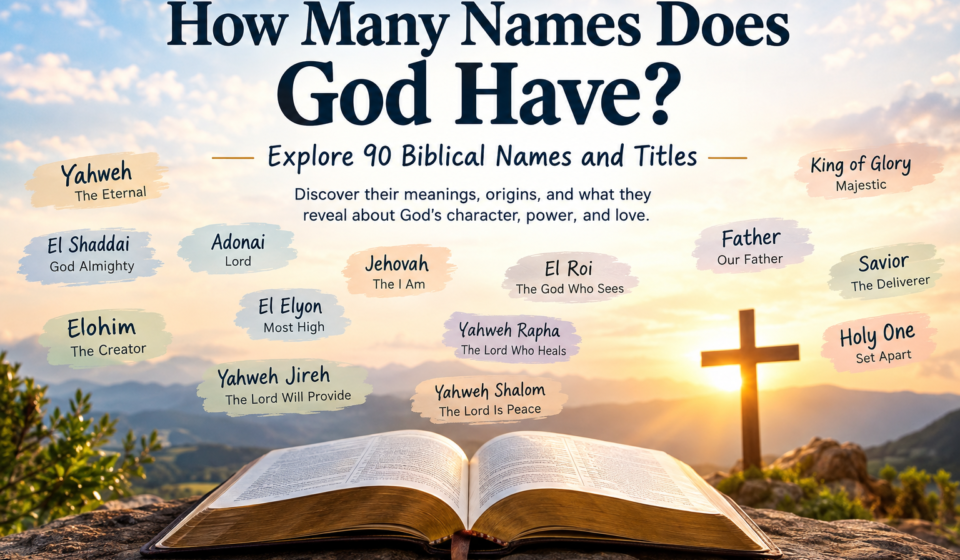

How many names does God have? The answer depends on the religion, scripture, and tradition you follow. In the Bible, God is known by many names and titles that describe His character, power, love, holiness, and relationship with humanity. This guide explores important names of God, their meanings, biblical origins, and how different names help believers understand His nature.
Biblical Names of God and Their Meanings
There is no single universally agreed number of names for God in the Bible. Some names are personal names, while others are titles, descriptions, or phrases used to explain God’s character.
Main Hebrew Names of God
These names come from the Hebrew Scriptures, commonly called the Old Testament. They are among the most recognized names and designations used for God.
- Yahweh – The personal name of God in the Hebrew Bible; its precise etymology is debated.
- Jehovah – A traditional English rendering of the divine name YHWH.
- Elohim – A Hebrew term for God, emphasizing divine power and majesty.
- El – An ancient Semitic word for God, often associated with strength and power.
- Eloah – A Hebrew term for God, used especially in the Book of Job.
- Adonai – Lord or Master; a title expressing authority.
- El Shaddai – Traditionally translated as God Almighty; the exact origin of Shaddai is debated.
- El Elyon – God Most High, emphasizing God’s supreme position.
- El Olam – God Everlasting or God of Eternity.
- El Roi – Commonly translated as the God who sees me, associated with Hagar’s encounter with God.
- Ehyeh-Asher-Ehyeh – Often translated as “I Am Who I Am” or “I Will Be What I Will Be” (Exodus 3:14).
- Yahweh Sabaoth – The LORD of Hosts, referring to God as ruler over heavenly hosts.
- Yahweh Jireh – The LORD Will Provide; associated with Abraham’s experience in Genesis 22.
- Yahweh Rapha – The LORD Who Heals, based on Exodus 15:26.
- Yahweh Nissi – The LORD Is My Banner, associated with victory and protection in Exodus 17.
- Yahweh Shalom – The LORD Is Peace, associated with Gideon’s altar in Judges 6.
- Yahweh Tsidkenu – The LORD Is Our Righteousness, found in Jeremiah 23:6.
- Yahweh Rohi – The LORD Is My Shepherd, a traditional rendering of the phrase in Psalm 23:1.
- Yahweh Shammah – The LORD Is There, the name given to the city in Ezekiel 48:35.
- Yahweh Mekoddishkem – The LORD Who Sanctifies You, based on Exodus 31:13.
Names and Titles Showing God’s Power
These biblical titles emphasize God’s strength, authority, greatness, and role as Creator.
- God Almighty – A title emphasizing God’s supreme power.
- Most High – The highest and supreme God.
- Lord of Hosts – The ruler of heavenly armies or hosts.
- Sovereign Lord – A title expressing God’s supreme authority.
- King of Glory – A majestic title used in Psalm 24.
- King Eternal – A title emphasizing God’s everlasting reign, found in 1 Timothy 1:17.
- Creator – The One who brings creation into existence (Isaiah 40:28).
- Maker – The One who forms and creates (Psalm 95:6).
- Ancient of Days – A title in Daniel 7 describing God’s eternal majesty.
- The First and the Last – A title emphasizing God’s supremacy and eternity in Isaiah 44:6.
- Alpha and Omega – The first and last letters of the Greek alphabet, used as a title in Revelation.
- Beginning and End – A title expressing God’s sovereignty over the beginning and completion of all things.
- Almighty God – A title emphasizing unlimited divine power.
- Holy One of Israel – A title frequently used by Isaiah to describe Israel’s holy God.
- God of Israel – A designation connecting God with Israel and its covenant history.
Names That Describe God’s Love and Care
Many biblical titles help believers understand God’s care, protection, faithfulness, and relationship with people.
- Father – Describes God as Father; central to Jesus’ teaching in the New Testament.
- Abba – An Aramaic term meaning Father, expressing a close relationship with God.
- Shepherd – A title portraying God as one who guides and cares for His people (Psalm 23:1).
- Redeemer – One who rescues or restores His people.
- Savior – One who delivers from danger or destruction.
- Deliverer – One who rescues people from oppression or trouble.
- Refuge – A source of safety and protection (Psalm 46:1).
- Fortress – A picture of strength and security (Psalm 18:2).
- Rock – A symbol of stability, faithfulness, and protection.
- Shield – A symbol of divine protection (Psalm 3:3).
- Helper – One who provides help and support (Psalm 54:4).
- Comforter – One who brings comfort; the precise application of this title depends on the passage and Christian tradition.
- The Living God – A title emphasizing that God is living, active, and distinct from lifeless idols.
- God of Hope – A New Testament description associated with hope and joy (Romans 15:13).
- God of Peace – A New Testament title emphasizing peace (Romans 15:33).
Names and Titles Describing God’s Holiness and Wisdom
These titles describe God’s moral perfection, justice, wisdom, and faithfulness.
- Holy God – God who is completely holy and set apart from evil.
- Righteous Judge – God as the fair judge of human actions (Psalm 7:11).
- Judge of All the Earth – A title expressing God’s authority to judge all people (Genesis 18:25).
- Faithful God – God who keeps His promises (Deuteronomy 7:9).
- God of Truth – A title emphasizing God’s truthfulness and reliability.
- Jealous God – A biblical description of God’s exclusive covenant loyalty (Exodus 34:14).
- Merciful God – God who shows mercy and compassion (Deuteronomy 4:31).
- God of Justice – A description of God’s commitment to justice (Isaiah 30:18).
- The Eternal God – God who exists forever (Deuteronomy 33:27).
- The Everlasting Father – A title in Isaiah 9:6, interpreted differently across translations and Christian traditions.
New Testament Titles for God
The New Testament frequently uses the Greek words Theos (God) and Kyrios (Lord), along with titles that describe God’s relationship with believers.
- Theos – The Greek word commonly translated as God.
- Kyrios – The Greek word commonly translated as Lord or Master.
- Father of Mercies – A title praising God’s compassion (2 Corinthians 1:3).
- Father of Lights – A title used in James 1:17, referring to God as the giver of good gifts.
- God of All Comfort – A title emphasizing God’s ability to comfort people (2 Corinthians 1:3).
- God of Love and Peace – A description found in 2 Corinthians 13:11.
- God of Patience and Consolation – A description of God’s role in giving endurance and encouragement (Romans 15:5).
- The Blessed and Only Sovereign – A title emphasizing God’s unique sovereignty (1 Timothy 6:15).
- Lord God Almighty – A title used in Revelation to emphasize God’s power and authority.
- The True God – A New Testament expression emphasizing the true God in contrast to false gods (1 John 5:20).
Titles of Jesus in Christian Scripture
Christians understand Jesus in relation to God in different ways depending on their theological tradition. The following are specifically New Testament titles for Jesus, rather than all being personal names of God the Father.
- Jesus – The name given to Jesus; Matthew 1:21 connects it with saving people from their sins.
- Immanuel – Meaning “God with us” (Matthew 1:23).
- Son of God – A central title for Jesus in Christian Scripture.
- Son of Man – A title Jesus frequently uses for Himself in the Gospels.
- Word of God – A title for Jesus in Revelation 19:13.
- Lamb of God – A title associated with Jesus’ role in taking away the sin of the world (John 1:29).
- Good Shepherd – Jesus’ description of Himself in John 10:11.
- Light of the World – A title Jesus uses for Himself in John 8:12.
- Prince of Peace – A title in Isaiah 9:6 traditionally understood by Christians as referring to the Messiah.
- Wonderful Counselor – A title in Isaiah 9:6 associated with the promised ruler.
- Mighty God – A title in Isaiah 9:6 in many English translations.
- King of Kings – A title used for Jesus in Revelation 19:16.
- Lord of Lords – A title of supreme authority used in Revelation 19:16.
- The Way, the Truth, and the Life – Jesus’ description of Himself in John 14:6.
- The Resurrection and the Life – A title Jesus uses in John 11:25.
- The Bright Morning Star – A title associated with Jesus in Revelation 22:16.
- The Firstborn from the Dead – A title for Jesus in Colossians 1:18.
- The Image of the Invisible God – A description of Jesus in Colossians 1:15.
- The Alpha and the Omega – A title used in Revelation, with its application interpreted within the passage and Christian tradition.
- The Amen – A title for Jesus in Revelation 3:14.
How to Choose the Right Name of God
Choosing a name of God for prayer, Bible study, or personal reflection depends on what you want to understand about God’s character.
- Consider the meaning: Choose a name that reflects a quality you want to focus on, such as peace, strength, mercy, or wisdom.
- Read the biblical context: Check the verse where the name appears to understand its original meaning.
- Understand the language: Hebrew, Aramaic, and Greek words may have several possible English translations.
- Respect different traditions: Jewish, Christian, and other religious traditions may use different names and interpretations.
- Avoid treating every title as a personal name: Words such as Creator, Shepherd, and Savior describe God’s role or character rather than necessarily being separate personal names.
Does God Have 365 Names?
Some Christian books, sermons, and devotional resources collect 365 names or titles of God or Jesus, often presenting one for each day of the year. However, 365 is not a universally established biblical total.
The number changes according to which scriptures, translations, titles, descriptive phrases, and compound Hebrew expressions a writer includes. It is more accurate to say that the Bible uses many names and titles for God than to claim there is one official count.
What Is the Difference Between God’s Name and His Titles?
A personal name identifies someone, while a title describes a role, quality, or position.
For example, Yahweh is commonly recognized as God’s personal name in the Hebrew Bible. Lord, Creator, Shepherd, and Redeemer are titles or descriptions that express authority, creative power, care, and deliverance. Some compound Hebrew expressions are traditionally called names of God, although their grammatical form and interpretation can vary.
Frequently Asked Questions
How many names does God have in the Bible?
There is no universally agreed total. The Bible uses personal names, titles, and descriptive phrases for God, and the number depends on how each category is counted.
What is God’s real name?
In the Hebrew Bible, God’s personal name is represented by the four Hebrew consonants YHWH. It is commonly rendered as Yahweh in scholarship and as Jehovah in some English religious traditions.
What are the seven names of God?
Lists of seven names vary by religious tradition. A commonly taught Christian list includes Yahweh, Elohim, Adonai, El Shaddai, El Elyon, El Olam, and Yahweh Sabaoth, although this is a teaching convention rather than a definitive biblical count.
Does God have 100 names or 1,000 names?
Neither number is an official total shared by all biblical traditions. Different lists may reach 100 or more by including titles, compound names, and descriptions of God’s character.
Are the names of God the same in every religion?
No. Judaism, Christianity, Islam, and other religious traditions use different languages, scriptures, and theological understandings of God. Even within Christianity, some names and titles are interpreted differently.
Conclusion
How many names does God have? The Bible offers many names and titles, but no single universally accepted total. Each one provides a different way to understand God’s character, power, mercy, and relationship with humanity.